 suwandi-tan
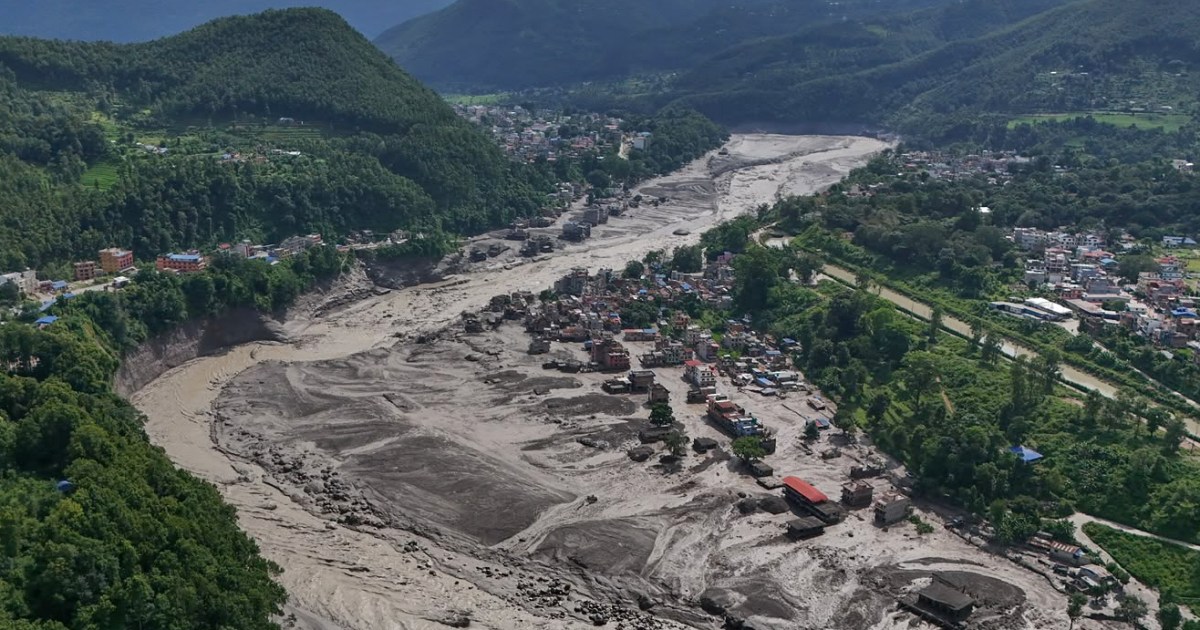
A wall of water unleashed by an avalanche of ice and rock has torn through villages and critical infrastructure along a river valley in Nepal's Himalayan north, killing at least eight people and leaving hundreds more feared missing, officials said on Wednesday.
The catastrophe struck at approximately 9am local time (03:15 GMT), when a sudden torrent surged down the Bhotekoshi river, sweeping away settlements in its path. Authorities say 384 tourists have not been heard from since the flood hit, among them 291 foreign nationals holding citizenship from India, Malaysia, the United Kingdom and the United States.
Rasuwa district, which borders Tibet, bore the brunt of the deluge. The floodwaters did not stop there, however, with the surge continuing downstream and prompting alarm across a wide swath of central Nepal. Officials issued emergency warnings telling residents living near three major waterways – the Bhotekoshi, the Trishuli and the Narayani – to move away from the banks immediately.
The destruction left behind was extensive. Roads linking communities in the mountainous north were torn apart, and multiple hydropower installations along the affected rivers were damaged or completely destroyed. The Nepal Electricity Authority estimated that roughly 430 megawatts of generating capacity was knocked out, encompassing both hydropower plants and solar facilities.
Government spokesperson Sasmit Pokharel told reporters that Kathmandu had reached out beyond its borders in its hour of need, saying requests for assistance had been sent to both India and China to bolster ongoing search and rescue operations.
The Nepali army confirmed it had dispatched helicopters along with specialized disaster response teams to the hardest-hit zones, where rescuers are working to reach isolated areas cut off by the flood damage. Prime Minister Balendra Shah summoned an emergency session of the National Disaster Risk Reduction and Management Authority to coordinate the government's response and evaluate the full scope of the devastation.
For residents of Rasuwa, Wednesday's tragedy carried grim echoes of the recent past. Almost exactly one year ago, in August, a glacial lake sitting just across the border in Tibet overflowed, unleashing floods that claimed nine lives and wrecked a vital bridge connecting the two countries.
Scientists who examined the latest disaster believe they understand how it unfolded. Experts at the International Centre for Integrated Mountain Development determined that an avalanche composed of ice and rock, originating on the Nepali side of the frontier, slammed into and dammed the Lhende Khola, a smaller river feeding into the Bhotekoshi. The natural barrier held back water only briefly before collapsing catastrophically, sending an abrupt and violent wave of water rushing downstream into populated areas.
Researchers noted that the incident highlights mounting dangers throughout the Himalayan range, a region warming faster than much of the planet. Rising temperatures are destabilizing glaciers and swelling glacial lakes, creating conditions in which such avalanche-driven floods become increasingly likely.
The timing of the disaster falls squarely within South Asia's annual monsoon season, which runs from June through September and reliably brings torrential rainfall to the region each year. The seasonal downpours routinely set off landslides and flooding that claim lives across Nepal, India, Bangladesh and neighbouring countries. Climate scientists warn that global warming is amplifying both how often these extreme weather episodes occur and how severe they become when they do – a trend now written in stark terms across the flooded valleys of northern Nepal, where families continue to wait for word of loved ones still unaccounted for.-- END --


Comments (0)