

Germany Returns to Growth After Three-Year Recession, Chancellor Merz Says
BERLIN — Germany's economy has begun growing again after a three-year recession, Chancellor Friedrich Merz has declared, announcing a turning point for Europe's largest economy at
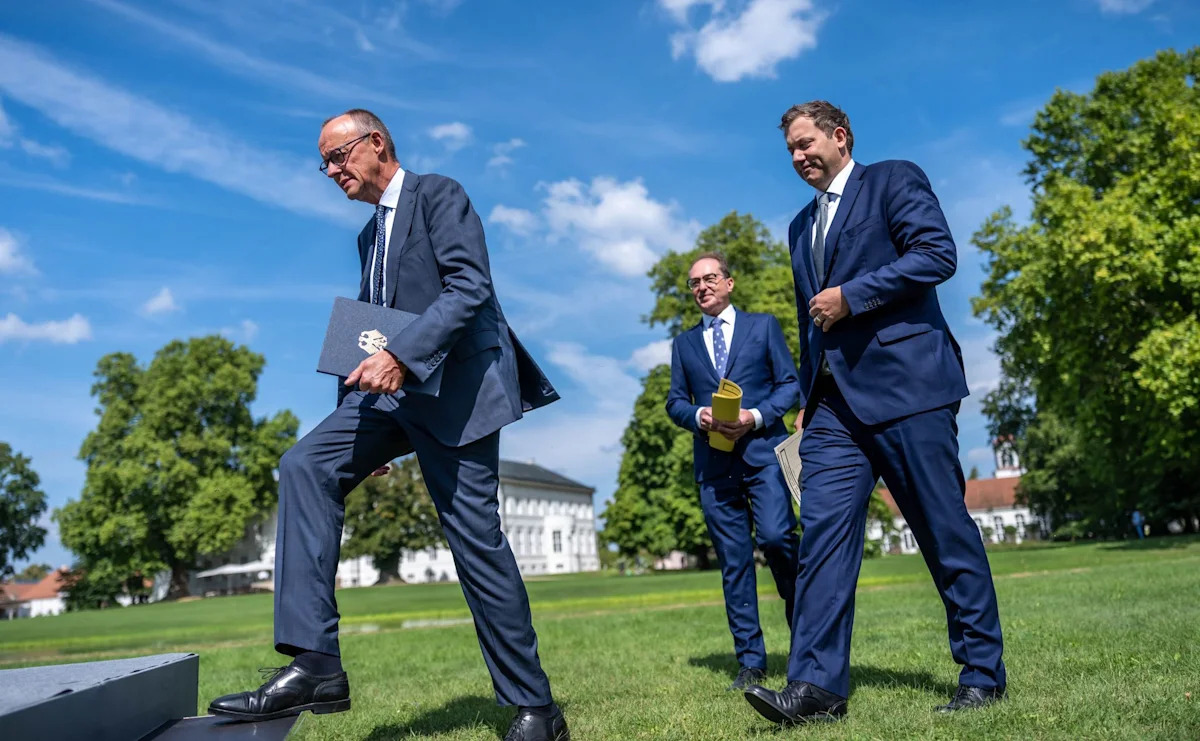
BERLIN — Germany's economy has begun growing again after a three-year recession, Chancellor Friedrich Merz has declared, announcing a turning point for Europe's largest economy at the end of its longest stretch of contraction in more than two decades.
The chancellor's announcement draws a line under a painful chapter. Gross domestic product shrank in both 2023 and 2024 — leaving Germany the only major advanced economy to contract for two consecutive years — and the stagnation persisted through a third year before activity finally swung back into positive territory. Along the way, major employers from carmakers to machinery producers announced job cuts, while consumers held back on spending and confidence in the traditional German economic model eroded.
Economists trace the downturn to a convergence of shocks. The country's industrial base never fully recovered from the loss of inexpensive Russian natural gas following Moscow's invasion of Ukraine, which left manufacturers facing energy bills far above those of American and Asian rivals. The automotive sector, long the engine of German prosperity, struggled with the shift to electric vehicles and intensifying competition from Chinese manufacturers. Protectionist turns in United States trade policy clouded the outlook for export-dependent industry, while elevated interest rates weighed heavily on construction.
Against that backdrop, Merz presented the renewed growth as evidence that the worst of the crisis has passed and that the economy is set on a path to broader recovery. His message amounts to a bet that the policies pursued by his government since taking office are beginning to bear fruit.
Those policies have been substantial. The governing coalition loosened Germany's constitutionally enshrined debt brake to allow unlimited borrowing for defense, unlocked a special fund of roughly half a trillion euros for infrastructure and climate-related investment spread over more than a decade, and approved tax incentives designed to encourage companies to bring forward purchases of new equipment. The government has also promised to slash bureaucracy and accelerate planning approvals that have slowed projects for years.
There are tentative signs the medicine is working. Business sentiment surveys have brightened in recent months, order books in key sectors have steadied, and the construction industry is positioned to benefit from the coming wave of publicly financed projects. Lower borrowing costs from the European Central Bank have eased financing conditions across the eurozone, providing additional support.
Analysts remain cautious nonetheless. Much of the current momentum stems from public spending rather than a self-sustaining pickup in private demand, they note, and exporters continue to confront tariffs abroad as well as subsidized Chinese competitors at home. Households, whose purchasing power was eroded by several years of high inflation, may not feel the recovery in their daily lives for some time.
Deeper structural problems also loom. Germany faces an aging workforce and persistent shortages of skilled labor, sluggish digitalization, dense regulation, and energy costs that remain well above those of key competitors. Without sustained reform, some economists warn, the current upswing could prove short-lived once the initial boost from state investment fades.
The stakes for Merz are considerable. He took office in May 2025 promising to restore Germany's economic vitality after the downturn became the dominant concern of voters and helped fuel the surge of the far-right Alternative for Germany. Delivering a durable recovery is widely seen as essential to his coalition's political credibility.
The implications extend well beyond Germany's borders. The country accounts for roughly a quarter of eurozone output, so a genuine German rebound would lift growth across the entire currency bloc, spurring demand for goods and services from France, Italy, Central Europe and beyond. For now, officials in Berlin are celebrating the return of growth — while acknowledging that transforming it into lasting prosperity is the harder task ahead.
--- END ---
What's Your Reaction?
 Like
0
 Dislike
0
 Love
0
 Funny
0
 Wow
0
 Sad
0
 Angry
0

Reporter MotoGP/Formula 1. Meliput balapan motor dan mobil internasional.


Comments (0)